7 Cold Email Benchmarks Every Founder Should Know Before Sending
The average cold email reply rate dropped to 3.43% in 2026, down from 5.1% a couple of years ago. Roughly 95% of cold emails still never get a response at all. If your campaigns feel harder than they used to, the data agrees with you: inboxes are more crowded, filters are tighter, and generic sends get punished fast.
This article breaks down the cold email benchmarks that matter this year, how they shift by company size, and where most campaigns leak performance before they ever reach a prospect's inbox.
- The 7 core 2026 benchmarks for reply rate, open rate, bounce rate, and more
- How to adjust your approach for small, medium, and large target companies
- Where campaigns typically fall short of benchmark, and how to fix it
P.S. We run managed outbound programs against these exact benchmarks every day, so if you'd rather skip the trial-and-error, book a call and let a managed team run point instead.
TL;DR
- The average cold email reply rate is 3.43% in 2026; top performers (elite tier) clear 10%+.
- Open rate is a deliverability metric, not a copy metric — average sits near 27.7%, far higher on warmed, managed domains.
- Bounce rate should stay under 3%, with best-in-class programs holding under 1.5%.
- Follow-ups generate 42% of all replies, so multi-touch sequences consistently beat one-and-done sends.
- Benchmarks shift with company size: small companies reward precision, large companies reward personalization at scale.
The 7 cold email benchmarks that matter in 2026
Most "average" benchmarks you'll find online blend managed and unmanaged sends into one meaningless number. The table below separates the benchmarks worth tracking from the vanity metrics, using the latest 2026 data.
Elite senders combine hyper-relevant subject lines, sub-80-word first emails, and a single clear call-to-action. Multiple CTAs dilute focus and drag reply rate down.
Cold email benchmarks by company size
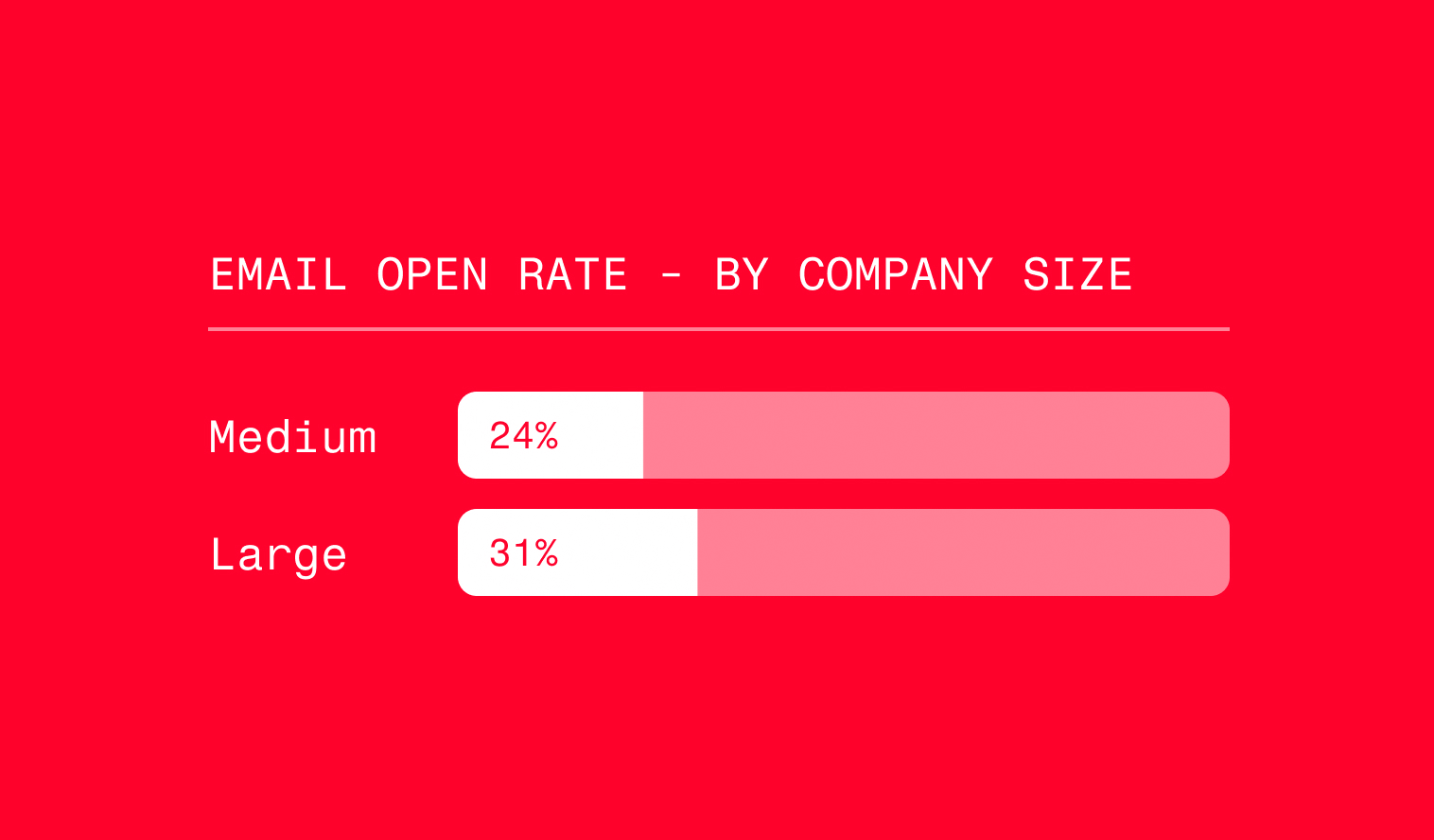
Benchmarks aren't one-size-fits-all. The right level of personalization, message length, and follow-up cadence changes depending on how big the company on the other end of your email is.
Small companies (1-10 employees)
You're emailing someone wearing five hats at once, so your message has to earn attention in seconds. Precision beats volume here: state why you're emailing, what value you bring, and end with one clear CTA. A tight, well-structured intro email does more work here than a long, feature-heavy pitch.
- Advanced personalization (beyond a first name) can push reply rates as high as 18%, roughly 2-3x the generic-template average.
- Keep the email short: elite performers stay under 80 words on the first touch.
- One CTA only. Asking for two things at once kills response rate.
Medium companies (11-100 employees)
With more employees comes more room to either go short-and-sweet or add a bit more context about the problem you solve. Either approach works if it's tied directly to a challenge this team is likely facing.
- Lead with the specific problem, not your product: problem-first positioning consistently outperforms feature-first pitches.
- Include a CTA, but keep it low-pressure: the goal is a conversation, not a forced meeting.
- Use follow-ups. They're responsible for 42% of replies, so stopping after one email leaves nearly half your possible responses on the table. A structured email cadence is what turns that follow-up math into booked meetings instead of ignored threads.
Large companies (100+ employees)
Large companies get more cold email than anyone, so generic sends disappear fast. Subject-line discipline matters more here than anywhere else: short, hyper-relevant subject lines that reference a specific problem or trigger event consistently outperform generic ones, especially on mobile.
- Personalization still matters at scale: reference something specific to the team, role, or trigger event, and keep enough personality in your sales emails that they don't read like a template.
- Keep subject lines tight and outcome-focused rather than clever.
- Test send timing: Tuesday-Wednesday consistently shows the strongest reply rates across 2026 benchmark data.
Where most campaigns fall short of benchmark
Founders and sales teams don't usually lose to a bad idea. They lose to weak execution: a domain that isn't warmed, a list that isn't fresh, or a sequence that stops after one email. Each of those gaps caps your reply rate before copy even enters the picture.
This is exactly the gap a fully-managed outbound system is built to close. At Key Outreach, we run infrastructure, list building, copywriting, and meeting booking as one connected process: dedicated sending domains, text-only formatting, and weekly-refreshed lists sourced from a proprietary 60M+ contact database, never a static purchased list.
In-house teams rarely have time to warm domains properly, test subject lines every week, or keep follow-up sequences on schedule, which is exactly what our Infrastructure, Email, and Email + Calling tiers are built to handle: deliverability setup, targeting, sending, and booking, end to end. The track record backs it up. Since 2015, these programs have booked 30,000+ meetings and influenced $170M+ in revenue, with documented ROI ranging 2x to 31x across 33 published case studies, including a 31x ROI engagement with NEWMEDIA.COM built on the same deliverability-first infrastructure.
Under our guarantee, we commit to 10x your pipeline during the pilot, or keep working for free until we do. That's a level of risk reversal that's hard to replicate with a solo in-house hire running one campaign at a time.
Hit these benchmarks with Key Outreach's managed system
Cold email benchmarks are achievable, but only with disciplined infrastructure, fresh targeting, and follow-up sequences run consistently. That's exactly what a managed outbound program is built to deliver.
Key Takeaways
- The 2026 average reply rate is 3.43%, with top performers exceeding 10% through micro-segmentation, testing, and problem-first messaging rather than sending more volume.
- Open rate is a deliverability signal, not a copywriting score. Warmed domains and clean lists matter more than clever subject lines alone.
- Company size changes the playbook: small companies need precision and brevity, large companies need sharper subject lines and personalization at scale.
- Follow-up sequences generate 42% of all replies, so stopping after one email, which nearly half of senders do, leaves real pipeline on the table.
P.S. If benchmarking your own numbers against this data raises more questions than it answers, book a call with our team and we'll walk through what a managed program would look like for your pipeline.
Frequently asked questions
What is a good cold email reply rate in 2026?
A good cold email reply rate sits around 3.43% on average, with top-quartile senders reaching 5.5% and elite performers clearing 10%. Hitting the top tier usually comes from micro-segmentation, weekly A/B testing, and problem-first messaging rather than volume alone.
What is a good cold email open rate?
Open rate depends heavily on deliverability, not copy. A raw, unwarmed send typically lands 15-25% opens, while a properly warmed and rotated sending setup can push well past that. Treat a low open rate as a domain health issue first.
How many follow-ups should a cold email sequence include?
Follow-ups generate roughly 42% of all replies, so a sequence of at least three to five touches captures far more responses than a single send. Nearly half of senders stop after one email, leaving significant reply volume unclaimed.
Do cold email benchmarks change by company size?
Yes. Smaller companies respond best to short, hyper-personalized emails with one clear CTA, while larger companies require sharper subject-line discipline and personalization at scale to cut through heavier inbox volume than smaller targets typically face.
How can I improve my cold email deliverability?
Keep bounce rate under 3%, spam complaints under 0.3%, and use dedicated sending domains instead of your primary domain. Fresh, verified lists and gradual volume increases protect domain reputation and directly raise your cold email benchmarks over time.