
Pay-for-Performance Appointment Setting: Price, Pros & Pitfalls
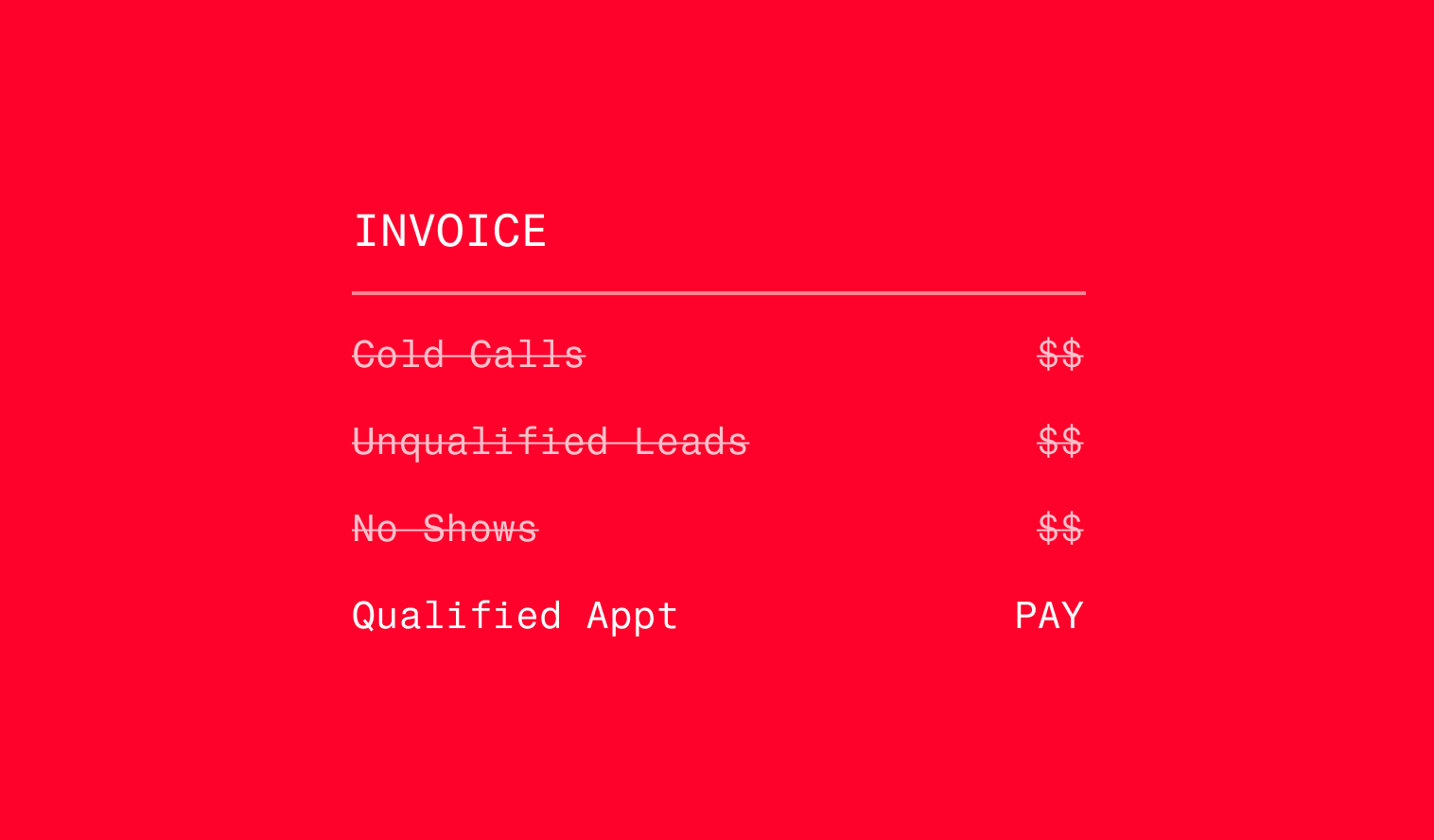
"Pay for performance" includes at least seven pricing models, and the differences between them determine how much risk you're transferring to your provider.
Two vendors can both call themselves performance-based and mean completely different things. One bills when a calendar invite is created. Another bills when a meeting advances to a real opportunity in your CRM. It’s the same label with wildly different economics, and a buyer who doesn't ask which one is on the table often finds out in month three.
Here's what this guide covers:
- The seven performance units vendors bill on — from per lead through to per closed deal — and what each one incentivizes
- The funnel-depth principle that explains why the "safest-sounding" models are usually the weakest
- The ICQ Test — three questions that expose incentive misalignment in any performance model before you sign
P.S. We've run managed outbound programs across SaaS, agencies, creator platforms, and B2B services. If you'd rather skip the model comparison and see what a full team could book for you, book a call with Key Outreach.
TL;DR
- Performance-based pricing is an umbrella, covering per-lead, per-booked-meeting, per-held-meeting, per-qualified-meeting, per-opportunity, per-closed-deal, and hybrid structures.
- The billing trigger is the whole negotiation. The further down the funnel the trigger sits, the more risk the provider carries and the more it costs per unit.
- Nobody sells pure per-closed-deal outbound at scale, because the provider can't control your close rate. Anyone offering it is usually pricing in something else.
- The ICQ Test (Incentive–Criteria–Quality) works on any performance model, not just per-appointment deals.
- Performance pricing and performance guarantees are different mechanisms. One changes how you're billed; the other adds a remedy if a threshold isn't met.
- Documented managed programs have produced 2X–31X ROI across 33 case studies, with a guarantee layer rather than per-unit billing.
What "pay for performance" actually means in outbound
Pay-for-performance appointment setting is any commercial structure where some or all of your fee is tied to a defined outcome rather than to time, activity, or headcount. That's the whole definition. Everything else — what the outcome is, how it's verified, who arbitrates a dispute — is negotiable, and those negotiables are where the money is.
The useful way to think about it is risk transfer. In a pure retainer, you carry the risk: you pay whether or not the program produces. In a pure outcome model, the provider carries it. Most real contracts sit somewhere between, and the position on that spectrum is set by one decision — where you put the billing trigger.
Three things follow from that, and they hold across every model below:
- The trigger defines the incentive. A provider optimizes for whatever event releases payment. We’re not being cynical; that's how any commercial arrangement works. Choose the trigger you actually want optimized.
- Deeper triggers cost more per unit. Paying on an opportunity costs more than paying on a booked meeting because the provider absorbs the drop-off between them.
- Verification has to be defined upfront. A trigger nobody can audit is a trigger that will be disputed. Who confirms the meeting happened? What's the rejection window? Get it in writing.
The seven performance units, compared
Every performance-based offer in this category bills on one of these events, or a combination of them. Here's the full spectrum, ordered by how far down the funnel the trigger sits.
Per lead and per contact
You pay for delivered contacts that match a stated profile. The provider bears almost no risk, since a contact record is easy to produce and hard to disqualify. This is data purchasing wearing performance-model clothing. If a vendor pitches this as pay-for-performance appointment setting, they've moved the trigger so far up the funnel that "performance" no longer means anything.
Per booked meeting
Payment releases when a calendar invite exists. It sounds like outcome-based pricing and behaves like activity-based pricing, because the provider's revenue is unaffected by whether anyone shows up. If a vendor bills on booked-only, ask directly what happens to their revenue when your show rate falls to 40%. If the answer is "nothing," you've found the flaw.
Per held meeting
Payment releases when the prospect attends. This is the most common credible version of per-meeting billing, and it introduces a real incentive: the provider now cares about confirmation sequences, reminder cadence, and booking windows that people actually keep. Show-rate accountability is the minimum bar for calling a model performance-based. The full economics of this structure — benchmark rates, setup fees, minimums, and the cost-per-opportunity math that matters more than cost per meeting — are covered in the pay-per-appointment breakdown.
Per qualified meeting
Payment releases when a held meeting also meets documented criteria: title, company size, industry, geography, sometimes intent signals. This is where performance pricing starts doing useful work, and it only functions if the criteria are specific and written before the first invoice. Vague criteria plus a per-qualified-meeting price is the worst of both structures, because you'll pay a premium rate and still argue about what counts.
You also need a rejection mechanism with a defined window — 48 or 72 hours is typical — and a rule for what happens to a rejected meeting. Does it come off the invoice? Does it get replaced? Silence on this point is a contract you'll regret.
Per opportunity
Payment releases when a meeting advances to a defined stage in your CRM. The provider is now absorbing the gap between "good conversation" and "real pipeline," which is a meaningful amount of risk, and the unit price reflects it. This model demands CRM visibility and a shared definition of the qualifying stage, so it works best with providers you've already run a program with rather than as a cold start.
The upside is that it aligns provider incentives with the only outbound metric that survives a board meeting. The friction is arbitration: stage progression is partly a function of your AEs' behaviour, which the provider doesn't control.
Per closed deal and revenue share
Payment releases when revenue is recognized. Almost nobody offers this for outbound appointment setting, for a straightforward reason: the provider controls the top of the funnel and none of the rest. Your pricing, product, AEs, and sales cycle all determine the outcome they'd be paid on.
When you do see it offered, it usually comes with something else attached — a long lock-in, a high floor, control over your sales process, or a large base fee. Read the whole structure before treating it as risk-free.
Hybrid: base plus performance layer
A monthly base covers the system — infrastructure, list building, copy, sending, reply handling — and a performance component rides on one of the triggers above. This is increasingly the default in managed programs, because it funds the parts of outbound that compound while keeping accountability attached to an outcome.
The trade-off is contract complexity. Get the per-unit math explicit, confirm which trigger the bonus attaches to, and check whether the base changes if the bonus consistently pays out.
The funnel-depth principle
Buyers gravitate toward the models that feel safest — pay only for a meeting, no meeting no fee. But the shallower the trigger, the less the provider has staked, and the less their incentives resemble yours. A per-booked-meeting deal transfers almost nothing. A per-opportunity deal transfers a lot. The "risk-free" option is frequently the one where the provider has the least reason to care what happens after the invite goes out.
So the question to bring to a vendor call is not "do you offer performance pricing?" It's how deep into my funnel are you willing to put the trigger, and what does that cost per unit? The answer tells you how much confidence they have in their own targeting.
However, there's a practical ceiling. Push the trigger deep enough and the provider is being paid on things they can't influence, which produces either a refusal or a price that erases the benefit. The workable range for most B2B companies sits between held meetings and opportunities.
Performance pricing versus performance guarantees
These get conflated constantly, and they're separate mechanisms that can coexist.
- Performance pricing changes how you're billed. Fees attach to units — meetings, opportunities, deals — so spend scales with output.
- A performance guarantee leaves billing alone and adds a remedy. You pay a defined fee, agree on a threshold, and if the threshold isn't met, something happens: continued work at no cost, a refund, a credit, or an early exit.
Guarantees have one structural advantage over per-unit pricing. Because the provider isn't paid per unit, they have no reason to inflate unit counts, which removes the volume-over-quality pressure that per-meeting models create. The catch is that a guarantee is only as strong as its remedy and its threshold, so read both. "Satisfaction guaranteed" with no defined threshold is marketing.
For example, Key Outreach runs a monthly retainer with a guarantee layer rather than per-unit billing: 10x your pipeline during the pilot, or we keep working for free until we do.
The ICQ Test: stress-testing any performance model
Whichever unit a provider bills on, the same three questions expose whether their incentives line up with your pipeline. Run the ICQ Test — Incentive, Criteria, Quality — before signing anything.
1. Incentive alignment
Ask: "What happens to your revenue if my show rate drops to 40%?"
A provider whose revenue is unaffected by show rate has no reason to protect it. This question works on every model in the table above, and the answer places them on the risk-transfer spectrum faster than any explanation they'll offer voluntarily.
2. Criteria enforcement
Ask: "How are qualification criteria documented, and what happens when a unit doesn't meet them?"
Get specific before signing: title, company size, industry, geography, intent signals, rejection window, and remedy. A provider who resists tight criteria is telling you they plan to cast a wide net, because tight criteria make volume harder to hit.
3. Quality feedback loop
Ask: "If I reject a unit as unqualified, how does that change your targeting next week?"
In a well-run program, rejections feed directly into list refinement and copy iteration, so the system improves. In a transactional structure, each unit is an isolated event and nothing compounds. A provider who can't describe the mechanism doesn't have one.
Due diligence beyond the pricing model
The billing structure is one variable. These confirmations apply regardless of which unit you land on, and they're where most programs quietly fail:
- Dedicated sending domains, never your primary — this protects your deliverability if their outreach draws spam complaints
- Fresh, targeted data built on a recurring basis rather than a static purchased file that degrades into bounces
- Multi-channel outreach, since email-only programs miss prospects who respond better to a call
- Documented case studies with ROI, not meeting counts — meetings that didn't convert prove nothing
- Clear contract structure, including term length, notice period, and exit terms
- Infrastructure ownership, meaning deliverability setup, inbox warm-up, and domain configuration are their problem
- Criteria and verification defined before billing starts, not after the first batch lands on your calendar
For a closer look at how these numbers stack up across providers, review the B2B appointment-setting cost breakdown before you negotiate.
Choosing a model: the maturity path
Most buyers treat this as a permanent, binary choice. It isn't, and the providers who understand outbound will tell you the same.
- Stage 1 — Validate. A per-meeting or per-qualified-meeting arrangement is an efficient way to test whether a new ICP or offer responds at all, without committing to a full program. Keep the criteria tight and the term short.
- Stage 2 — Systematize. Once the motion is proven, a managed retainer builds the parts that compound: dedicated infrastructure, weekly list building, and copy tested against real reply data. This is where a guarantee layer usually beats per-unit pricing, since you want the provider optimizing quality rather than count.
- Stage 3 — Scale. Layer in cold calling for higher-intent accounts, add small-batch LinkedIn as a warm second touch, or open new verticals on the same infrastructure.
Key Outreach's six-month initial commitment maps to Stage 2, after which programs run month-to-month with 60-day notice. The system covers ICP definition, weekly list building from LinkedIn Sales Navigator, Apollo, Seamless, Winmo and a proprietary 60M+ contact database, copywriting, dedicated sending domains, inbox monitoring, and meeting booking. Onboarding and domain warm-up run through weeks one to three, first emails go out around week four, and meetings build as engagement compounds. See how the full process works before you compare providers.
What the outcomes look like
Model comparison only matters against documented results. These came from managed retainer programs with a guarantee layer rather than per-unit billing:
Across 33 documented programs, Key Outreach has booked 30,000+ meetings and influenced $170M+ in revenue since 2015, with ROI ranging from 2x to 31x.
Ready for predictable pipeline? Key Outreach can help
Performance-based pricing is a spectrum, and the label on the proposal tells you far less than the trigger buried in clause four. Before you sign anything, find out which of the seven units you're actually buying, how deep in the funnel it sits, and what happens when a unit doesn't meet criteria.
Here's the decision in plain terms:
- Choose a shallow per-unit model if you're validating a new ICP with a narrow, well-documented target profile and a short sales cycle
- Choose a deeper per-unit model if you have CRM transparency, an established relationship with the provider, and a sales cycle long enough that meeting counts mislead
- Choose a guaranteed retainer if you want a compounding system and would rather the provider optimize for quality than for unit volume
- Choose in-house if every conversation demands deep product knowledge and you have the budget and management bandwidth to build and retain a team
The ICQ Test applies to all of them. Use it before you sign.
Key Outreach runs the entire outbound motion — ICP, lists, copy, dedicated infrastructure, and booked meetings — so your team stays focused on closing. Our guarantee is simple: 10x your pipeline during the pilot, or we keep working for free until we do.
P.S. If you're ready to see what a managed program could book for you, Key Outreach makes it straightforward. One call, a clear plan, and a team that runs the whole system. Book a call to get started.
Frequently asked questions
What is pay-for-performance appointment setting?
Pay-for-performance appointment setting is any commercial structure where your fee is tied to a defined outcome rather than to time or headcount. It's an umbrella term covering at least seven billing triggers: per lead, per booked meeting, per held meeting, per qualified meeting, per opportunity, per closed deal, and hybrid base-plus-bonus arrangements. The trigger a provider uses determines how much risk they're actually carrying.
What's the difference between pay-per-lead, pay-per-appointment, and pay-per-opportunity?
They're three points on the same spectrum, separated by how far down the funnel the billing trigger sits. Pay-per-lead releases payment when you deliver a matching contact. Pay-per-appointment releases when a meeting is booked or held. Pay-per-opportunity releases when that meeting advances to a defined CRM stage. Each step down the funnel transfers more risk to the provider and costs more per unit.
Is performance-based pricing the same as a performance guarantee?
No. Performance pricing changes how you're billed, attaching fees to units of output. A performance guarantee leaves the billing structure alone and adds a remedy if an agreed threshold isn't met — continued work, a refund, a credit, or an early exit. The two can coexist, and a guarantee avoids the volume-over-quality pressure that per-unit billing creates.
Can I pay an appointment setting company only when a deal closes?
Almost no provider offers this for outbound, because they control the top of the funnel and none of your sales process. When it is offered, it usually comes with a long lock-in, a high base fee, or control over how deals are worked. Treat a pure commission offer as a signal to read the rest of the contract closely.
How do I know whether a provider's incentives align with mine?
Run the ICQ Test: incentive alignment (does their revenue move when your show rate drops?), criteria enforcement (how specific is the qualification definition, and what's the rejection remedy?), and quality feedback loop (do rejected units change next week's targeting?). A provider who answers all three clearly has a structure built around your pipeline rather than their invoice.