Sales Development Services: What’s Included & How to Choose
Most companies evaluating sales development services are already doing some form of outbound, but they’re probably doing it inconsistently, expensively, or both. The real question isn’t whether you need sales development. It’s whether you’re building the right system to make it predictable.
This guide covers everything you need to make that call:
- What sales development services actually include — and what separates a real program from a simple email blast
- How to compare in-house vs. outsourced — with honest cost and timeline benchmarks
- How to evaluate providers — using a concrete framework, not vendor promises
P.S. Key Outreach has run this system across 33 documented programs, booking 30,000+ meetings and influencing $170M+ in revenue since 2015. If you’d rather skip the research and see what a managed program could book for you, book a call here.
Sales development services are outsourced or managed programs that handle prospecting, outreach, lead qualification, and meeting booking on behalf of a B2B sales team — generating qualified pipeline without the company hiring and managing its own SDR staff.
TL;DR
- Sales development services cover ICP definition, list building, copywriting, sending infrastructure, and meeting booking, end-to-end.
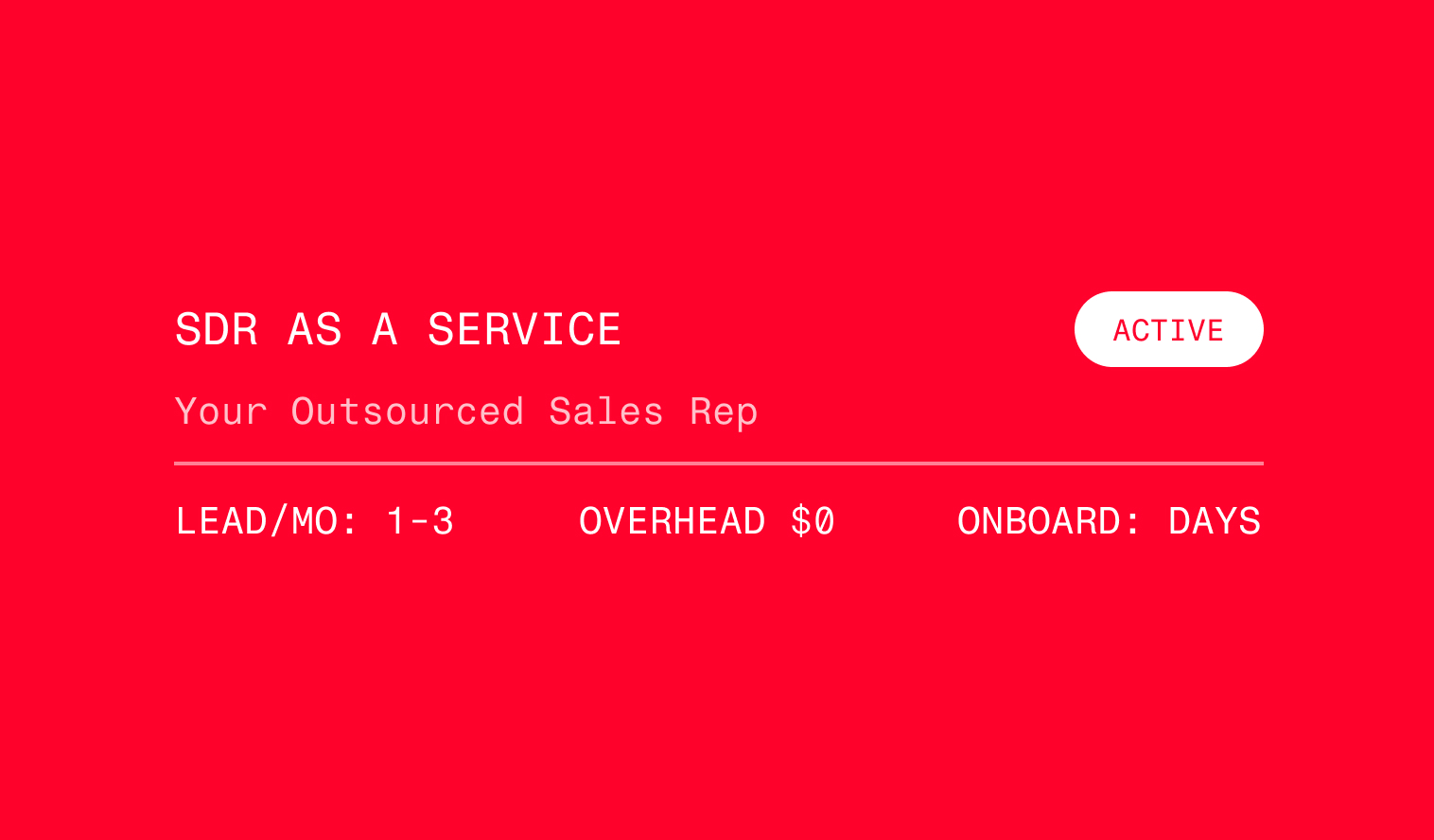
- A managed program launches in roughly 3–4 weeks and costs a fraction of a fully loaded in-house SDR ($110K–$160K/yr before tools).
- Email is the engine. Cold calling adds speed. LinkedIn adds warmth. Layer channels deliberately, not by default.
- Evaluate providers on infrastructure ownership, fresh list building, human operators, and documented ROI — not meeting volume promises.
- The best programs are measured on meetings booked and revenue influenced, not opens, clicks, or “leads.”
What sales development services actually include
“Sales development services” is a broad label, and what you’re actually buying varies wildly between providers. Some hand you a list of contacts and call it prospecting. Others run the entire front end of your pipeline — from ICP to booked meeting — without you lifting a finger. Before evaluating anyone, let’s clarify what a complete program should cover.
ICP definition and list building
The foundation of any B2B sales development program is knowing exactly who to target and building fresh lists that reflect that. A provider that skips this step and blasts a purchased database is setting your program up to fail before the first email goes out.
A strong provider will define your Ideal Customer Profile collaboratively — industry, company size, titles, pain points, buying triggers — and then build fresh, targeted prospect lists weekly against that profile. The difference between fresh weekly lists and a static purchased database directly determines whether your outreach lands with in-market buyers or bounces off stale contacts.
Key things to look for in a provider’s data approach:
- Data sources: LinkedIn Sales Navigator, Apollo, Seamless, and Winmo are the industry standard. A proprietary contact database adds depth.
- List freshness: Weekly builds beat static lists every time — stale data decays fast and tanks deliverability.
- ICP specificity: Generic “B2B companies” targeting is not an ICP. Titles, company size, vertical, and trigger events all matter.
Key Outreach builds fresh lists weekly using Sales Navigator, Apollo, Seamless, Winmo, and a proprietary 60M+ contact database — never static lists — because targeting accuracy is what drives reply rates. See how the full managed lead generation program is structured.
Outreach copywriting and messaging
Messaging is the highest-leverage variable in outbound. A great list with mediocre copy produces mediocre results. A good provider writes, tests, and iterates copy continuously.
What separates real messaging from a mail-merge blast:
- Personalization by segment — not just
{{FirstName}}tokens, but relevant angles per vertical, title, or pain point - Sequenced follow-ups — a single email is rarely enough; a well-structured sequence builds on each touchpoint
- Ongoing A/B testing — subject lines, opening lines, and CTAs should be tested against reply data, not set-and-forgotten
Sending infrastructure and deliverability
Most buyers overlook infrastructure entirely, and it’s the single biggest reason outbound programs fail. If your emails don’t land in the inbox, nothing else matters. No amount of great copy rescues a program that’s landing in spam.
The non-negotiables for a deliverability-first setup:
- Dedicated sending domains — never send from your primary domain; a dedicated domain protects your brand if reputation takes a hit
- Domain warm-up — new domains need roughly 2–3 weeks of gradually ramping volume before hitting full send
- Text-only email format — HTML templates and images trigger spam filters; plain text lands cleaner
- Inbox monitoring — sender reputation needs active management, not a one-time setup
Key Outreach handles all infrastructure — dedicated domains, warm-up, text-only sending, and inbox monitoring. It’s a major reason we hold the #1 reply-rate position among 5,000+ agencies on SmartLead in 2025.
Meeting booking and handoff
The end deliverable of a sales development service is a qualified meeting on your calendar. If a provider measures success by anything short of that, ask why.
A clean handoff looks like this:
- Provider monitors inboxes daily and responds to interested prospects in real time
- Qualification criteria (agreed during onboarding) are applied before a meeting is booked
- Meeting is scheduled directly on your calendar — you show up, they’ve handled everything before it
- Your job starts at the meeting; everything before it is the provider’s responsibility
In-house SDR team vs. outsourced sales development services
Every company evaluating outsourced sales development is also weighing the “build vs. buy” question. Neither option is universally better — the right answer depends on budget, timeline, how quickly you need pipeline, and whether you want to manage the function at all. Here’s an honest breakdown.
The math is stark: a single fully loaded in-house SDR costs $110K–$160K per year before tools, and you get one person who still needs to ramp, be managed, and may churn. Key Outreach’s managed program gives you a full team — SDRs, SDR managers, strategists, and copywriters — on a monthly retainer, for a fraction of that. The six-month initial commitment transitions to month-to-month after that, and most programs are structured so that one closed deal covers the investment. For a deeper look at the tradeoffs, see the benefits of outsourcing an SDR company.
How a managed sales development program works (step by step)
Knowing what the first 90 days actually look like is what separates a confident buyer from the rest. Here’s the full lifecycle of a managed sales development engagement:
1. Discovery and ICP alignment
Before a single email is written, the provider needs to understand your business — your ideal buyers, your value proposition, your competitive landscape, and what a qualified meeting actually looks like for your team. We define the ICP collaboratively here, and it’s the strategic foundation everything else is built on.
2. Infrastructure setup (weeks 1–3)
Purchase, configure, and warm up dedicated sending domains. Inbox and deliverability systems are built. We draft, review, and get client approval on messaging structure and initial sequences before anything goes out.
This phase feels slow from the outside, but programs that skip it fail for a reason. Rushing the warm-up is how you end up in spam on week one.
3. List building and campaign launch (week 4+)
Fresh prospect lists are built to the agreed ICP. First outreach emails go out. Follow-up sequences are activated. The program is live, and the clock starts on compounding engagement.
4. Inbox monitoring, optimization, and meeting booking
The provider monitors inboxes daily, handles replies, qualifies interested prospects against the agreed criteria, and books meetings directly on your calendar. Copy, targeting, and sequences are tested and optimized continuously based on what’s working.
5. Reporting, iteration, and scale
Regular reporting covers activity, replies, meetings booked, and pipeline generated. Underperforming segments get cut; winning angles get doubled down on. At higher tiers, cold calling and LinkedIn can be layered in for additional volume.
Key Outreach’s three service tiers map directly to this progression:
What sales development services cost
Pricing is the question every buyer has but few providers answer transparently. Exact figures vary by provider, volume, and channels — but understanding the pricing model matters as much as the number itself.
Most legitimate outsourced sales development services run on a monthly retainer model, not pay-per-lead or pay-per-meeting pricing. This matters more than it sounds, and we’ll explain why in the next section.
Cost drivers to understand before you budget:
- Channels: Email-only programs cost less than email + calling + LinkedIn. Each channel adds infrastructure, headcount, and management.
- Volume: More outreach to a larger ICP universe means more list-building, more inboxes, and more optimization work.
- ICP complexity: Targeting a niche vertical with a long sales cycle requires more strategic lift than a broad horizontal play.
- Strategic involvement: Some providers are execution-only; others include strategy, messaging, and reporting at the retainer level.
The benchmark that matters most: a fully loaded in-house SDR costs $110K–$160K per year before tools. A managed program typically costs a fraction of that and gives you a full team, not one person. Most programs are structured so that one closed deal covers the investment.
Key Outreach runs on a tiered monthly retainer (Infrastructure / Email / Email + Calling), with a six-month initial commitment, then month-to-month with 60 days’ notice to cancel.
Channels used in sales development services
Not all channels are equal, and stacking them without a strategy burns budget and sender reputation. The providers with the highest reply rates know which channel to use first and why. Here’s how the three core channels work in a well-run program.
- Email — the engine. Primary channel for volume and reach. Sent from dedicated domains, text-only format, warmed for 2–3 weeks before volume ramps. This is where most meetings come from in a managed program. Everything else builds on a healthy email foundation.
- Cold calling — the accelerator. Optional add-on for higher volume and faster conversion. Works best when layered on top of email engagement signals — calling prospects who’ve already opened or replied compresses the time-to-meeting significantly compared to dialling cold into a void.
- LinkedIn — the warm touch. Small-batch only, intentionally limited because of the platform’s volume restrictions. Reserved for higher tiers or high-value accounts. Adds a personal touchpoint without tripping platform limits or getting the account flagged.
The key takeaway: Email is the foundation. Calling adds speed. LinkedIn adds warmth. A good provider lets you layer channels based on your goals and budget rather than forcing you into a one-size-fits-all “multi-channel” package that looks impressive on a slide deck but overloads your infrastructure on day one.
The PIPE framework: how to evaluate any sales development provider
The market is crowded with agencies that promise pipeline but deliver activity reports. Most buyers don’t have a structured way to cut through the noise, so here’s one. The PIPE framework gives you four concrete questions to ask any provider, in any vendor conversation.
- P — Profile: Does the provider define your ICP collaboratively and build fresh lists weekly, or do they buy a static database and blast it? Ask specifically: What data sources do you use, and how often do you refresh lists? A provider who can’t answer this clearly is running on autopilot.
- I — Infrastructure: Do they set up dedicated sending domains, warm them properly, and manage deliverability — or do they send from your primary domain and cross their fingers? Ask: Who owns the sending domains, and what does your warm-up process look like? If they don’t have a warm-up process, that’s your answer.
- P — Play: Do human strategists write, test, and iterate your messaging — or is it a template library with mail-merge tokens? Ask to see example sequences and their testing cadence. Messaging that never changes is messaging that stops working.
- E — Engage: Is the deliverable a booked, qualified meeting on your calendar — or a CSV of “leads” you still have to chase? If a provider measures success by opens, clicks, or MQLs, they’re optimizing for the wrong thing. The only metric that matters is meetings with buyers who fit your ICP.
Run any provider through PIPE before you sign. It maps directly to the infrastructure, data, copy, and deliverable questions that separate real operators from vendors who resell automation tools.
Why more channels ≠ more meetings
Here’s something most outsourced SDR agencies won’t tell you: stacking channels without a deliverability-first infrastructure hurts results. The “multi-channel is always better” pitch sounds compelling, but it’s often what kills a program early.
Here’s what actually happens when channels are added without the right foundation:
- LinkedIn at high volume trips the platform’s activity restrictions and gets accounts flagged or restricted — often within days of launch.
- Cold calling without email engagement signals means reps are dialling cold into a void, with no context and no warm signal to work from.
- High email volume on a shared or primary domain tanks sender reputation fast, and once you’re in spam, you don't get out quickly.
The providers with the highest reply rates aren’t the ones with the most channels. They’re email-first and deliverability-obsessed — they layer channels based on intent signals and program maturity, not by default. Don’t believe us? Key Outreach’s #1 position on SmartLead among 5,000+ agencies in 2025 is a direct result of this approach.
The question to ask any provider isn’t “how many channels do you offer?” It’s “why do you use each channel, and in what order?” If they can’t answer that, they’re selling a feature list, not a system.
The hidden cost of pay-per-lead pricing
Most buyers instinctively prefer pay-per-lead or pay-per-meeting pricing — it feels lower-risk. You only pay when something happens. But this pricing model often produces worse outcomes than a retainer, and here’s why.
Pay-per-lead incentivizes volume over quality. The provider gets paid for meetings booked, not for meetings that close. That misalignment is structural, and it shows up in the quality of what lands on your calendar.
What happens in practice:
- Providers optimize for booking speed, not ICP fit — which means you’re spending time on meetings that go nowhere
- List quality drops because the provider isn’t invested in infrastructure or targeting; they’re invested in throughput
- Follow-up sequences get aggressive and spammy, burning your sender reputation for short-term meeting counts
Retainer models align incentives differently. The provider invests in infrastructure, targeting, and copy quality because their renewal depends on pipeline results, not meeting count. When the program is built to last, the meetings it books are built to close.
Most buyers don’t think about this distinction until they’ve already burned three months on a pay-per-lead program that booked 15 meetings with the wrong people. For a full breakdown of how these models compare, see pay-for-performance appointment setting services.
Sales development services by industry
Sales development isn’t one-size-fits-all. The ICP, messaging, sales cycle length, and objection landscape differ dramatically between a SaaS company selling to CTOs and a creative agency selling to CMOs. A good provider has playbooks tailored to your vertical, not a generic sequence they repurpose for every client.
Here’s how managed sales development applies across the four verticals Key Outreach specializes in:
- SaaS lead generation: Long sales cycles, multiple stakeholders, crowded markets. Sales development services help SaaS companies move beyond inbound and founder-led selling to build repeatable outbound pipeline — reaching the right decision-makers before the competition does.
- Lead generation for marketing and creative agencies: Agencies live and die by referrals and networking. Managed outbound reaches CMOs and brand leaders directly — the decision-makers agencies struggle to get in front of through warm introductions alone.
- Creator and influencer platform outreach: The creator economy is a crowded space where everyone already knows everyone. Managed outbound breaks through existing relationship networks to reach new brands, agencies, and marketing teams that haven’t heard of you yet.
- B2B services lead generation: Complex solutions, long decision cycles, and internal teams too busy serving clients to prospect. Sales development services keep the pipeline moving without pulling anyone off delivery.
The proof spans verticals. Tagger — an influencer marketing platform — booked 5,000+ meetings at 3x ROI through Key Outreach’s managed program, supporting a $140M acquisition. Remix Logistics, a 3PL provider, booked 100+ meetings at 23x ROI and generated $500K+ in revenue, showing that managed outbound works well beyond software.
Results to expect from sales development services
Outbound is a compounding system, not a light switch. Setting the right expectations upfront is what separates a program that gets cancelled at month two from one that scales into a core pipeline channel.
Timeline: Expect 3–4 weeks of setup and domain warm-up before first emails go out. Meetings start building in the weeks that follow and compound as engagement data informs targeting and copy optimization.
Meetings: Across 33 documented programs, Key Outreach has seen results ranging from roughly 25 to 5,000+ meetings per engagement, depending on ICP size, offer, and program duration.
ROI: Documented ROI ranges from 2x to 31x. Most programs cluster around 3x–10x.
Revenue influence: Key Outreach has booked 30,000+ meetings and influenced $170M+ in revenue since 2015.
The range is wide because the inputs vary — ICP size, offer strength, sales cycle, and program duration all affect output. What doesn’t vary: programs built on solid infrastructure, fresh targeting, and human-run optimization consistently outperform programs that skip those fundamentals.
Ready to build predictable pipeline? Key Outreach can help.
Sales development services give B2B companies a predictable outbound pipeline without the cost and complexity of building an in-house SDR team. The right provider handles everything from ICP to booked meetings, and you evaluate them on infrastructure, data quality, deliverables, and documented ROI — not promises.
Here’s what to take with you:
- Sales development services handle prospecting, outreach, qualification, and meeting booking end-to-end — the right program runs the entire front end of your pipeline.
- A managed program costs a fraction of an in-house SDR ($110K–$160K/yr per rep before tools) and launches in weeks, not months.
- Email is the engine; calling adds speed; LinkedIn adds warmth — layer channels based on goals, not because a vendor sells all three.
- Use the PIPE framework (Profile, Infrastructure, Play, Engage) to evaluate any provider — it cuts through the noise fast.
- Expect 3–4 weeks of setup before first emails go out, with meetings compounding from there — outbound is a system, not a switch.
- The best programs are measured on meetings booked and revenue influenced, not opens, clicks, or contact counts.
Key Outreach runs your outbound end-to-end — ICP, lists, copy, sending, and booked meetings — so your team can focus on closing. Book a call to see how we’d build predictable pipeline for your business.
Frequently asked questions
What are sales development services?
Sales development services are managed or outsourced programs that handle the front end of the B2B sales process — ICP definition, prospecting, outreach, lead qualification, and meeting booking. The goal is a qualified pipeline of booked meetings so your closers can focus on deals, not prospecting.
How much do sales development services cost?
Most outsourced sales development services run on a monthly retainer model. Exact pricing varies by provider, volume, and channels — but the relevant benchmark is a fully loaded in-house SDR at $110K–$160K per year before tools. A managed program typically costs a fraction of that for a full team. Most programs are structured so that one closed deal covers the investment.
How long does it take to see results from outsourced sales development?
Expect 3–4 weeks of onboarding and domain warm-up before first emails go out. Meetings start building in the weeks that follow and compound over time as targeting and copy are optimized. Outbound is a system — it builds, it doesn’t spike.
What’s the difference between a sales development service and a lead generation agency?
The terms overlap, but the key distinction is the deliverable. A lead generation agency may hand you a list of contacts or MQLs. A sales development service books qualified meetings directly on your calendar — the prospect has been contacted, qualified, and scheduled. You show up to the meeting; everything before it is handled.
What channels do sales development services use?
The most effective programs are email-first — sent from dedicated domains, text-only, with a proper warm-up period. Cold calling is an optional add-on for higher volume and faster conversion. LinkedIn is used in small batches on higher tiers. The best providers layer channels based on intent signals, not by default.
What should I look for when evaluating a sales development provider?
Use the PIPE framework: Profile (do they build fresh, ICP-targeted lists weekly?), Infrastructure (do they own dedicated sending domains and manage deliverability?), Play (do human strategists write and test your messaging?), Engage (is the deliverable a booked, qualified meeting — not a “lead”?). Also ask for documented case studies with real ROI numbers, not vague testimonials.