Fiscal Year (Explained): A Guide for B2B Founders
Ever had a great discovery call, only to have it wrap up with “let’s revisit next year”?
Often, this is because of a simple misunderstanding about the fiscal year that even the most experienced B2B leaders can miss: the budget was locked months before you showed up, so a good fit stalls. It’s the result of B2B teams planning outreach on their own calendar while buyers budget on theirs.
Fortunately, our Plan-Lock-Spend-Flush framework shows what to send, and when.
In this guide, you’ll get:
- A clear definition, plus fiscal year vs. calendar year
- Federal, state, and global fiscal year dates
- A four-phase framework for timing outreach
P.S. We run fully managed outbound and have booked 30,000+ meetings since 2015. Book a call if you’d rather not build the machine yourself.
TL;DR
- A fiscal year (FY) is any 12-month period used for budgeting, accounting, and reporting. It doesn’t have to start January 1.
- “FY2026” usually means the fiscal year that ends in 2026. The U.S. federal FY runs from October 1 to September 30.
- Choose a fiscal year-end (FYE) that matches your operating cycle. Confirm entity-type rules with a CPA.
- If you sell B2B, your buyers’ fiscal years decide when budget exists. Use the Plan-Lock-Spend-Flush framework to time your outreach.
- Look up a prospect’s FY in minutes using SEC EDGAR, Form 990, state budget offices, or one discovery question.
What is a fiscal year?
A fiscal year (FY) is any 12-month period an organization uses for budgeting, accounting, and financial reporting. It can match the calendar year (January 1 to December 31) or start on any other date. For example, the U.S. federal government’s fiscal year runs October 1 to September 30.
Sources like the Cambridge Dictionary define it the same way: a 12-month period, “not always January 1st to December 31st,” for which a government or business plans its management of money. In the UK and elsewhere, you’ll also see it called a financial year.
Quick facts:
Fiscal year vs. calendar year: what’s the difference?
Every calendar year is technically a fiscal year, but not every fiscal year is a calendar year. The difference comes down to the start date and how well the period matches the organization’s natural operating cycle.
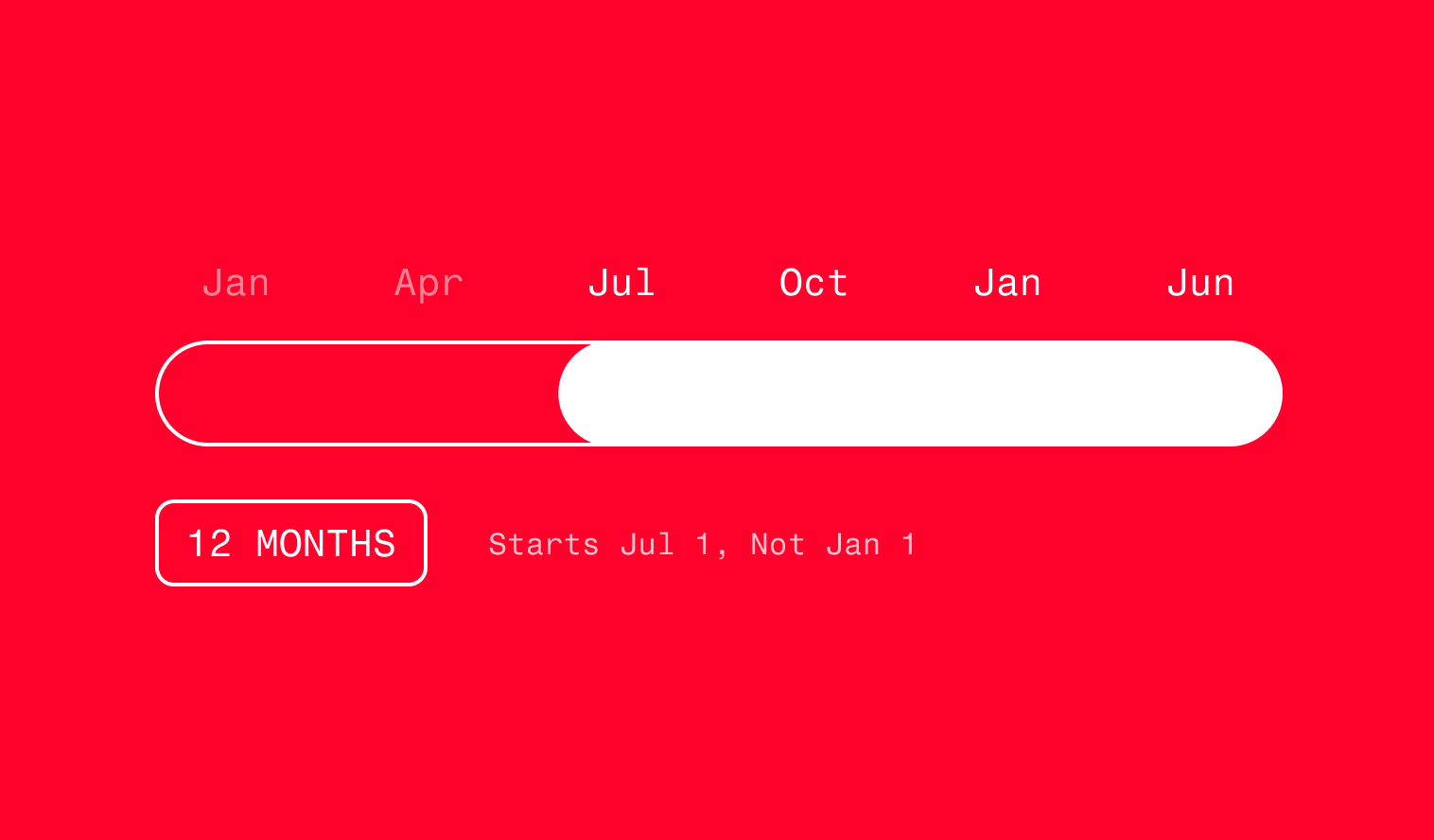
To translate a fiscal quarter into calendar months, start at the FY start month and count three months per quarter. If the FY starts July 1, Q1 is July to September, Q2 is October to December, and Q3 is January to March.
How fiscal years are named and dated
The naming convention trips people up. “FY2026” doesn’t necessarily mean calendar 2026. A fiscal year is named for the year in which it ends.
The U.S. federal fiscal year
The federal FY runs October 1 to September 30 and is named for the year it ends. FY2020, for example, began October 1, 2019, and ended September 30, 2020. That makes the federal FY2026 start in late 2025.
Common fiscal year start dates around the world
The start date depends on the country and the level of government.
Fiscal year examples from well-known companies
Public companies show how widely fiscal years vary. These are public examples only, drawn from each company’s 10-K filings.
Why do companies use a non-calendar fiscal year?
The best fiscal year captures one complete operating cycle, so related revenue and expenses land in the same period. That makes financial statements more meaningful.
- Seasonal revenue: Retailers end the FY after the holiday rush and returns, so the whole peak sits in one year.
- Grant-funded nonprofits: Align the FY with grant award periods so reporting matches funding.
- Agricultural businesses: Close the year after harvest and sale.
- Workload and audit availability: An FYE outside tax season makes CPAs and auditors easier to book.
- Industry or parent-company alignment: Match the reporting calendar of investors, a parent company, or key customers.
How to choose (or change) your company’s fiscal year
Choosing a fiscal year is a tax and operations decision. Confirm the details with a CPA. This is general information, not tax advice.
- Map your revenue by month for 12-24 months. Find your slowest month. Ending the FY just after it keeps the busy season inside one year and makes the close lighter.
- Check your entity type. C corporations can generally choose a fiscal year. S corporations, partnerships, and sole proprietors generally default to a calendar year. A fiscal year then requires a business-purpose showing or a Section 444 election (Form 8716).
- Consider a 52-53 week year if you run weekly operations (retail, staffing, logistics) and want every year to end on the same weekday.
- Align with stakeholders. Weigh investor reporting, lender covenants, and your biggest customers’ budget cycles.
- To change an existing tax year, file IRS Form 1128. Some changes qualify for automatic approval. Expect a short tax year for the transition period.
What happens at fiscal year-end?
The fiscal year-end is when the books close and the next year’s plan gets locked. The last item on the finance team’s checklist matters most for selling.
- Reconcile accounts, inventory, and accruals.
- Close the books and produce annual financial statements.
- Schedule the audit or review.
- File returns on the schedule tied to your tax year.
- File the 10-K (public companies) within 60, 75, or 90 days of FYE for large accelerated, accelerated, and non-accelerated filers, respectively.
- Finalize next year’s budget. Outsiders forget this step, and it matters to anyone selling to you.
The same timing logic applies to your own calendar, starting with how you prepare your sales team for Q4.
The mistake: selling on your calendar
Most agencies and B2B service firms plan pipeline around their calendar: a Q4 slowdown, then a “new year push” in January. But a prospect whose FY starts July 1 set its budget in spring. A state agency’s budget follows the legislature. A federal buyer may be spending hard in September.
Pitching on your calendar means arriving after the money is allocated. That’s why “great call, let’s revisit next year” happens so often. It’s a timing failure, not a fit failure.
The Plan-Lock-Spend-Flush framework
Every buyer’s fiscal year moves through four phases, and each phase calls for a different message. Treat this as a working model, not a statistic. Phase lengths vary by organization.
Evidence for the Flush phase: Liebman and Mahoney’s study of federal procurement, “Do Expiring Budgets Lead to Wasteful Year-End Spending? Evidence from Federal Procurement” (American Economic Review, 2017), found that spending in the final week of the fiscal year was roughly 4.9x the weekly average for the rest of the year.
Why timing compounds: Gartner research finds that a typical B2B buying group for a complex solution involves 6-10 decision-makers. The more people who must approve, the more a deal depends on being in the plan before the Lock phase.
How to find a prospect’s fiscal year in five minutes
Most fiscal years are public or one question away.
Add an “FY start month” field in your CRM. Use it to build monthly outreach segments, such as “accounts entering Plan phase in the next 60 days.”
How to build outbound around buyer budget windows
Once you know the FY, work backward from the Plan phase. Outbound takes time to stand up properly, so starting the week a planning window opens is already late.
- Segment your target list by FY start month. Prioritize the accounts entering the Plan phase next.
- Count backward for setup time. A safe program needs dedicated sending domains, never your primary domain. Those domains need a few weeks of warm-up, ramping volume gradually, before real sending begins.
- Match message to phase. Use the framework table: ideas in Plan, quick starts in Lock, gap fixes in Spend, scoped projects in Flush.
- Refresh lists continuously. Budget owners change at FY turnover, so build fresh lists rather than relying on static ones.
- Measure on meetings booked per window, not opens. Tag each account with its phase and compare booked meetings across segments.
If you don’t have the bandwidth to stand this up before the next planning window, Key Outreach runs the whole motion for you. Our fully managed outbound program covers ICP definition, fresh weekly list building, copywriting, dedicated sending domains, inbox monitoring, and meeting booking. Onboarding and domain warm-up take weeks 1-3, and first emails typically go out in week 4. That’s why it pays to start a month or more before your buyers begin budgeting.
Agencies stuck on referrals have also turned outbound into a repeatable channel. Digital agency NEWMEDIA.COM booked 65+ meetings at a 31x ROI, and OOH/experiential agency NPRP Media booked 560+ meetings at a 10x ROI. Both used managed outbound programs.
Fiscal-year-aware cold email templates
Phase-matched copy beats generic “checking in” emails. Keep it short, plain text, and specific.
Plan-phase template:
Subject: Next year’s [function] plan
Hi [Name], teams at [Company] are usually mapping next fiscal year’s priorities around now. If [specific goal, e.g., “more qualified pipeline for the new service line”] is on the list, I have a 3-step plan from similar [industry] teams. Worth sending over?
Flush-phase template:
Subject: Before [Company]’s year-end
Hi [Name], if there’s [function] budget left before your fiscal year closes, we scope [specific deliverable] so it can start fast and finish clean. Open to a 15-minute look?
If your team is too busy serving clients to segment by fiscal year and write phase-specific sequences, a managed program can take that work off your plate, the way we run outbound lead generation for B2B services firms.
Know the timing, then call Key Outreach
A fiscal year is any 12-month reporting period. Choose yours to match your operating cycle. If you sell B2B, your buyers’ fiscal years decide when your pitch can become a deal.
Key takeaways:
- Define it: A fiscal year is any 12-month period for budgeting and reporting. “FY2026” usually means the year ending in 2026, and quarters count from the FY start.
- Choose it: Match your FYE to your operating cycle. Check entity-type rules, use Form 1128 to change, and confirm everything with a CPA.
- Look it up: Find prospects’ fiscal years through EDGAR, Form 990, state budget offices, or one discovery question. Store the FY start month in your CRM.
- Time it: Segment by FY, match your message to Plan, Lock, Spend, or Flush, and start setup weeks before the window opens.
Key Outreach runs your outbound end-to-end (ICP, lists, copy, sending, and booked meetings) so your team can focus on closing. We’ve booked 30,000+ meetings and influenced $170M+ in revenue since 2015. If you’re ready to see how we’d build predictable pipeline for your business, book a call.
FAQs
What does fiscal year mean?
It’s a 12-month period used for budgeting, accounting, and reporting. It may or may not start January 1.
Is a fiscal year the same as a tax year?
Not always. A tax year is the period used for tax returns, and it can match your fiscal year, which for many businesses it does.
Does a fiscal year have to be 12 months?
Normally yes. The exceptions are a 52-53 week year or a one-time short tax year when you form a business or change years.
What does FY24 or FY2026 mean?
The fiscal year ending in that calendar year.
When does the fiscal year start?
It depends on the organization. The U.S. federal fiscal year starts October 1, most U.S. states start July 1, and the UK, Canada, India, and Japan start April 1. Companies can pick any start date that fits their operating cycle.
What is Q1 of a fiscal year?
The first three months after the FY start date, which isn’t necessarily January-March.
Can a company change its fiscal year?
Yes, usually by filing IRS Form 1128. Some changes need IRS approval.
Why does the U.S. government use October 1?
The Congressional Budget Act of 1974 moved the federal FY start from July 1 to October 1 to give Congress more time to pass appropriations.